Bauplan at VLDB 2026


VLDB 2026
Among data conferences, we have a soft spot for VLDB, which is where the white paper on Bauplan's architecture was first shared: it is impressive both how far we have come since then and how relevant that work still is!
The only developers who can bring data applications to production are those who possess a special data engineering skill set. [...] Systems should allow users to use only familiar tools like SQL, standard Python, the CLI and Git.
This year, our week in Boston gave us the chance to present three VLDB papers — in collaboration with researchers from CMU, Columbia University, University of Maryland, UW-Madison, University of Milano-Bicocca — and a DataFusion open-source benchmark — in collaboration with Stanford University, Together AI and UW-Madison.
Presenting our work in front of the best researchers on the planet is not just a privilege, but a chance to compare our roadmap and vision to those of mature organizations, as well as with theoretical research directions. So, what were the best vision talks we attended?
Vision talks
There was no shortage of Bauplan friends among keynote speakers, invited speakers and panelists (so we are perhaps a bit biased!). Three talks were particularly interesting:
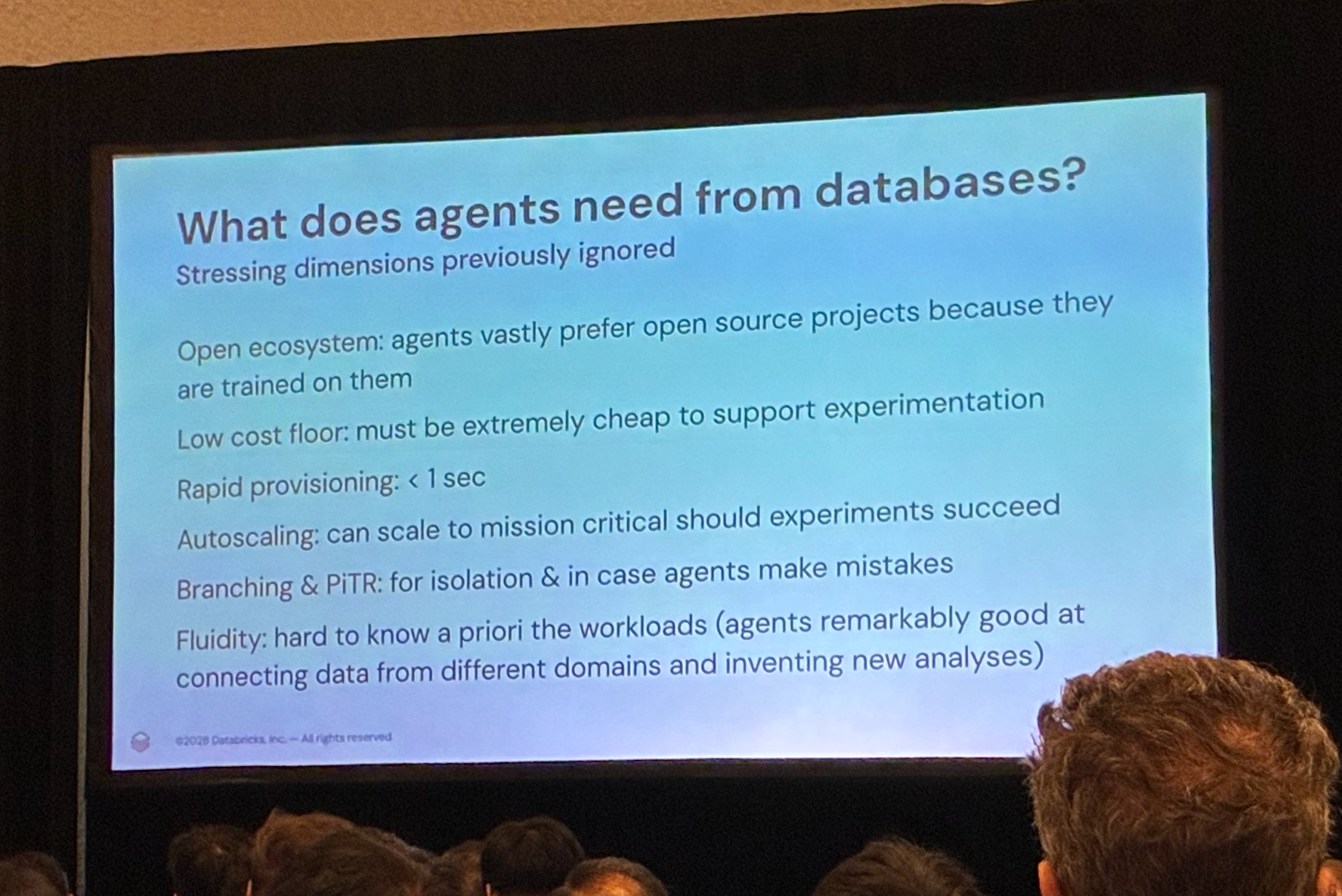
- Reynold Xin, Databricks co-founder, clearly identified this moment as one of the few times in a career when systems are rebuilt and new research and commercial opportunities arise. Comparing the current wave of “agentic-first” data systems in magnitude to the previous shift he lived through at Databricks (the era of big data cloud systems), Reynold briefly presented the (truly excellent) Lakebase paper and laid out a few dimensions that had previously been ignored when building systems (see the slide below!).
- Bauplan POV: while Reynold clearly identified branching (more on that below) as one of the most important data primitives, the stats shown reveal a peculiar pattern. In addition to offering limited Git semantics, Neon databases mostly live for a few seconds, supporting quick testing but limited production use cases (in other words, you discard the data branch you just created and keep the code). Bauplan branches have a much higher average lifespan; moreover, given that workloads are expensive (say, changing 10M rows), efficient merging is an important topic to avoid duplicate work.
- Aditya Parameswaran, Berkeley professor and co-director of BAIR, gave a DASHSys keynote that combined the SAO agenda - i.e. data systems need to be rebuilt for agents as their primary users - with some stories from the trenches, as he has recently been leading research on agentic analytics at Snowflake. Particularly impressive are the stats on adoption (two-thirds of Snowflake customers use a coding agent) and the query patterns visible in traces, often with hundreds of queries run by agents for exploration within minutes.
- Bauplan POV: as we worked with Aditya on the SAO workshop earlier this year, the degree of overlap with our vision is not surprising. Two interesting new directions that were mentioned are satisficing (i.e. returning approximate results faster, as agents can deal with uncertainty by doing more exploration) and semantic hints (i.e. data systems can return detailed suggestions to the client on what to do next, query patterns, etc., with the idea that humans may be overwhelmed by this information but agents could make good use of it).

- Eugene Wu, Columbia professor and co-director of the Data, Agents, and Processes Lab (DAPLab), and his team were among the first researchers to identify branching as a new core data primitive. During his talk, Eugene stressed the importance of quickly moving from a read-only to a read-write perspective, as real automation needs to be about making changes to systems, not just speeding up reporting. He also nudged the data community to think about data from a broader perspective: what is branching when API calls, Notion docs, OLTP and OLAP are in a single workflow? What notion of transaction is appropriate for this brave new world?
- Bauplan POV: in line with the public numbers from Redshift and Snowflake, more than half of Bauplan's jobs are writes. Notably, when asked by the audience during the conference, both Eugene and Aditya called out Bauplan's Git-for-data as a major, novel approach for safe and concurrent data work! We are already working with Eugene’s group to port their benchmarks to the OLAP world (see our ongoing open-source effort with the fantastic Elaine Ang). Expect more announcements soon!
Bauplan research
We presented three research projects during the conference (all slides and materials available upon request!):
- "Skill Issues": Data-Centric Optimization of Lakehouse Agents (Nicole Rose Schneider, Davide Ghilardi, Giacomo Piccinini, Jacopo Tagliabue): our own open-source data evals and skill-optimization loop, which combines careful synthetic data generation with fine-grained verification through Git-for-data semantics.
- GitLake: Git-for-data for the agentic lakehouse (Weiming Sheng, Jinlang Wang, Manuel Barros, Aldrin Montana, Jacopo Tagliabue, Luca Bigon): our canonical presentation of GitLake, our Git-for-data abstraction layer. For the first time, we shared branching benchmarks against similar primitives in other platforms (e.g. 100x faster than Snowflake's zero-copy clone), as well as the Alloy model of transactional pipelines.
- Not Your Usual Type(s) (Aldrin Montana, Colin Marc, Luca Bigon, Jacopo Tagliabue): a composable “data contracts as code” strategy to naturally encode the semantics of tables and the (typed) flow of data in a DAG. A well-deserved shoutout goes to the CDMS organizers: the success of this workshop is another sign that (luckily) the composable ecosystem is alive and well, and we are thrilled to return to this venue year after year and see old and new faces.

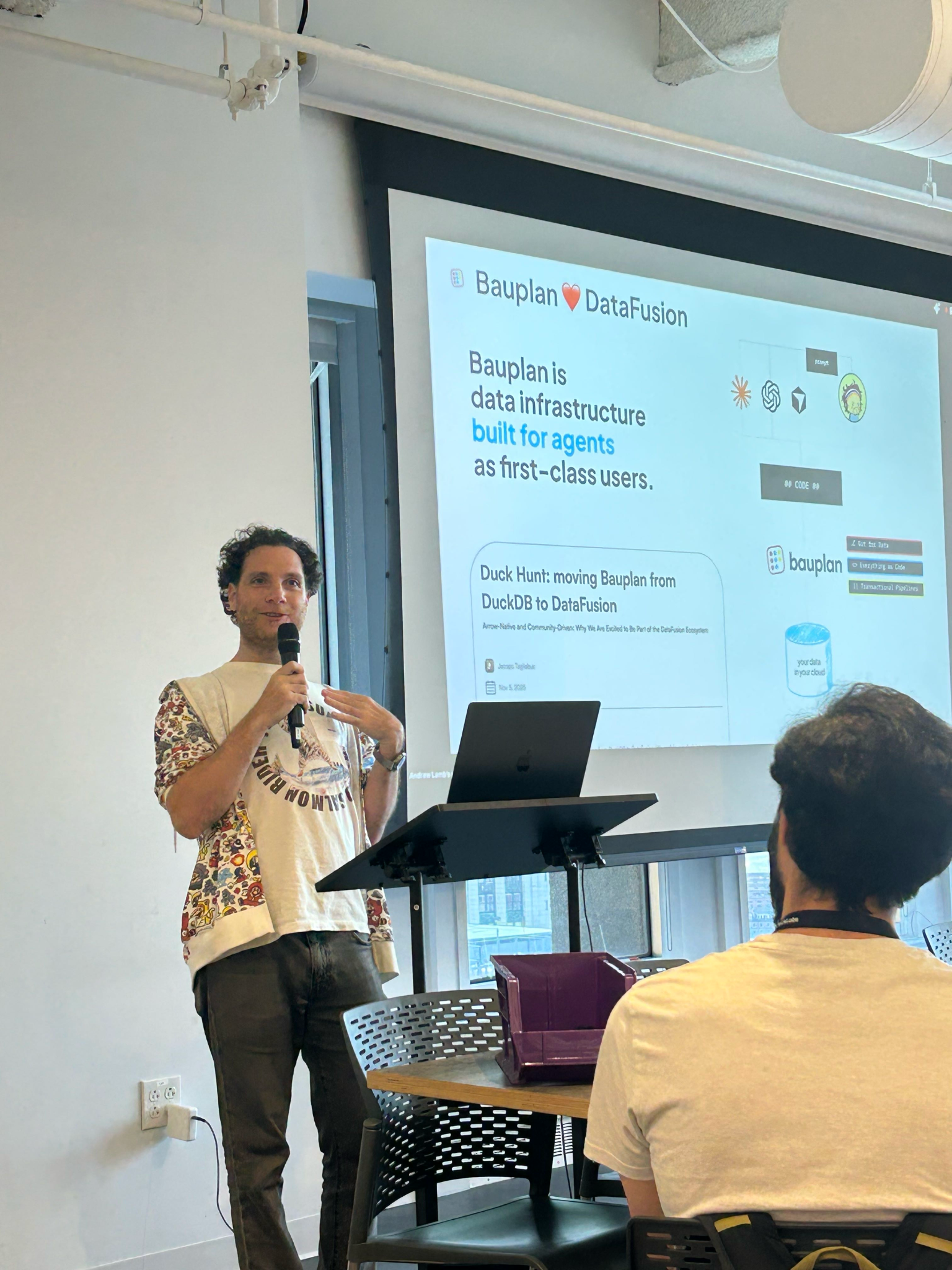
Finally, an honorable mention goes to a fantastic DataFusion meetup organized by folks at Datadog and Andrew Lamb: we are proud to be part of this community, and we pledge to continue helping it grow however we can. During the meetup, we presented our open-source, slightly crazy, definitely visionary project on semantic reasoning over DataFusion JOINs: we were overwhelmed and (positively) surprised by how much interest our experiments generated, and we spent a lot of quality time with the attendees diving deep into the future of AI-assisted performance optimization.
See you, data cowboys
As we wrap up VLDB, it is already time to look ahead to the next venue: follow us on LinkedIn, X and YouTube to see where we will be next, and feel free to reach out if anything above resonates with you. If this is indeed the third era of data systems (as Reynold says), we are (and will continue to be) at the forefront of this wave: we are hiring systems engineers excited by this opportunity!