Bauplan at AI Council 2026



AI Council 2026
Thanks to the incredible work from the team at AI Council, this year’s talks just hit YouTube (including ours!). In what Pete described as the “most successful and packed AI (Data) Council ever,” we had the chance to meet with old friends, make new ones and take the pulse of what the community is doing at the intersection of data and AI.
Anecdotally, we found that the Council is usually 6-12 months ahead of the market, so what we hear in the hallways there tends to become mainstream shortly afterwards. In our review, we picked three themes we care about and explained where we stand.
Theme 1: models are already smart enough, if they can try and fail
Claude Code is taking the market by storm, but Silicon Valley is already moving from the 1:1 chat model to the one-human-to-many-agents flow. Software scaling is complex but seems to be already on relatively solid conceptual ground: Git for concurrency control and review, fast local builds, verification-driven development (shoutout to our friend and investor Wes McKinney and his talk on agentic development!). Scaling data work is an entirely different story: cloud state is shared and changes can be disastrous for downstream consumers, the cloud life-cycle is slow and DevOps heavy, testing is non-standardized and often happens in its own separate cycle (e.g. “dbt run… dbt test”). Unsurprisingly, the solution most teams reach for is what we called “agent lobotomy”: we make data agents so constrained and dumb as to avoid undesired side effects.

If there is one thing we’d like the audience to learn from our own talk on this topic (a technical deep dive on how to build Git-for-Data), it is that constraining intelligence is not the path to scale. Models are already smart enough to accomplish most data work (“the self-driving data stack” TM) as long as the platform below them allows safe experiments and has purpose-built APIs. While every incumbent is trying to rebrand as the “agentic platform”, Bauplan’s Git-for-Data is >100x faster than alternative lakehouse branching solutions: on top of the AI Council video, you can check out our VLDB pre-print for a technical deep dive.
Theme 2: the semantic layer is not what it used to be
The “semantics” of “semantic layer” is notoriously a thorny issue, but everyone started to agree that at least one major component of any such platform is being disrupted by LLMs: if mapping metrics-to-queries was a “compiler” problem before, code generation has become good enough to sidestep the module entirely. Of course, there is still some disagreement on which level of autonomy we want / need (as Matthew and Paul debated in our recent round table), but even compared with Data Day Texas, the resistance to newer methods is going down.
On the other hand, what will happen to the properly “semantic” aspect is still unclear: where to store metrics, how to indicate suggested joins, who should record column meaning are open questions. Unsurprisingly, these are the questions at the intersection of technical challenges (authoring code, versioning definitions, balancing in-context tokens) and business needs (trusting self-service reports, shared understanding, concept ownership).
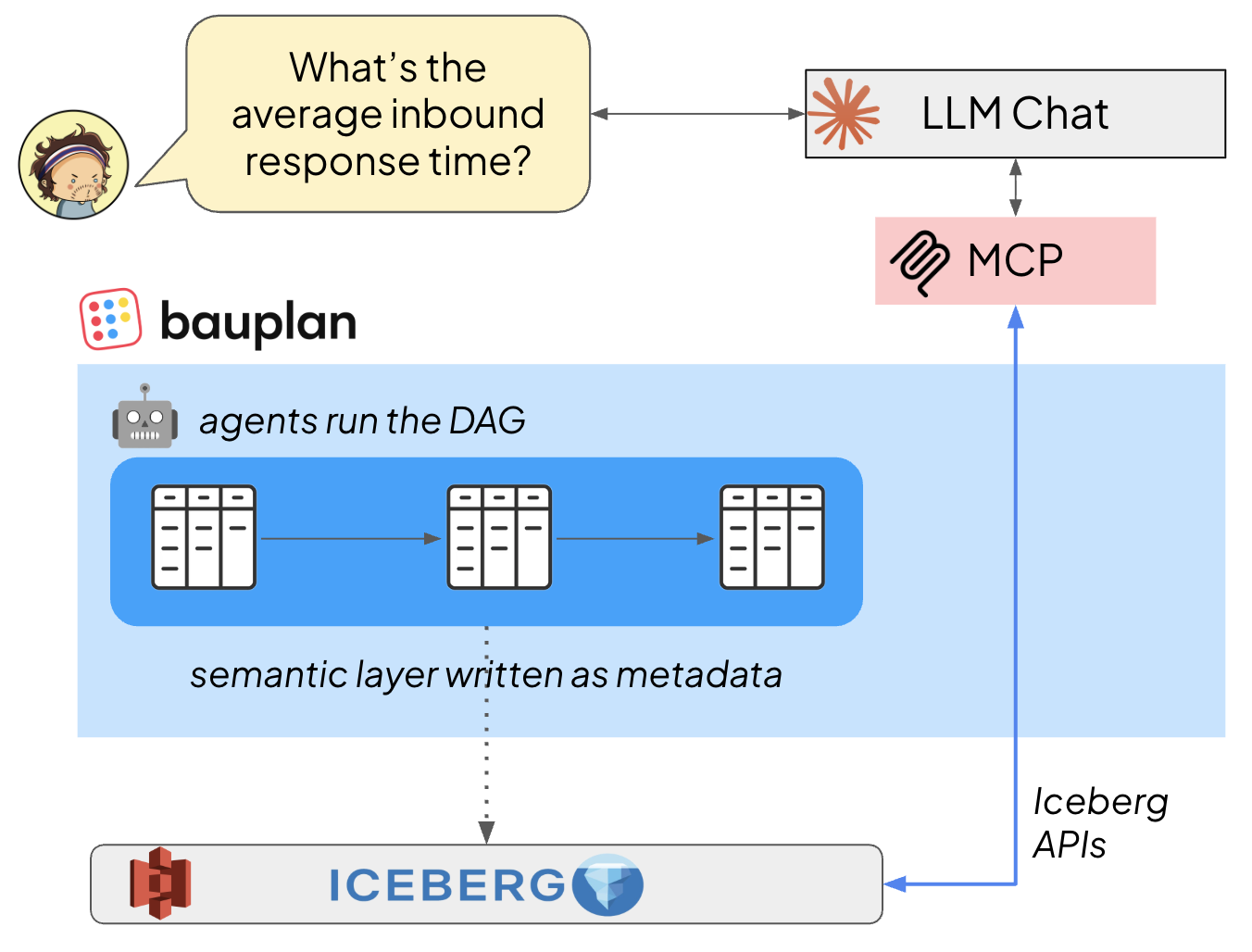
Bauplan’s own (radical?) proposal is to co-locate code and meaning (see our pre-print here): whoever writes the transformation code (a coding agent, most likely) should also describe the meaning of the data assets thus created and store them both as code (versioned in Git) and as data (versioned in Iceberg snapshots). The read path at that point instantiates a truly open lakehouse pattern: any MCP embedding an Iceberg client can retrieve table definitions and provide them as context for effective text-to-SQL.
Theme 3: the open-source ecosystem is alive and well
When bombarded with the big lab “projections” on token spending, it is easy to sleep on the (comparatively small, but still enormously impactful) open-source ecosystem. Even before the recent safety-related incidents, talks like Mozilla’s and Arcee’s reminded us of the importance of a healthy and thriving open source movement, from models themselves, to datasets, to the necessary “middleware” (API gateways, MCP governance, agent harnesses).
As use cases mature, open-source models improve and enterprises start to balance frontier tokens with cost-effective alternatives, “owning your intelligence” graduates from a Twitter motto to a more varied tooling landscape. We believe that providers of agentic infrastructure should stay model-and-stack agnostic. If anything, compatibility with the smallest, cheapest models is to be preferred as we don’t want to incentivize unnecessary token spending or increase lock-in for our customers; as we are not reselling OpenAI tokens, customers appreciate the decoupling that comes with Bauplan.
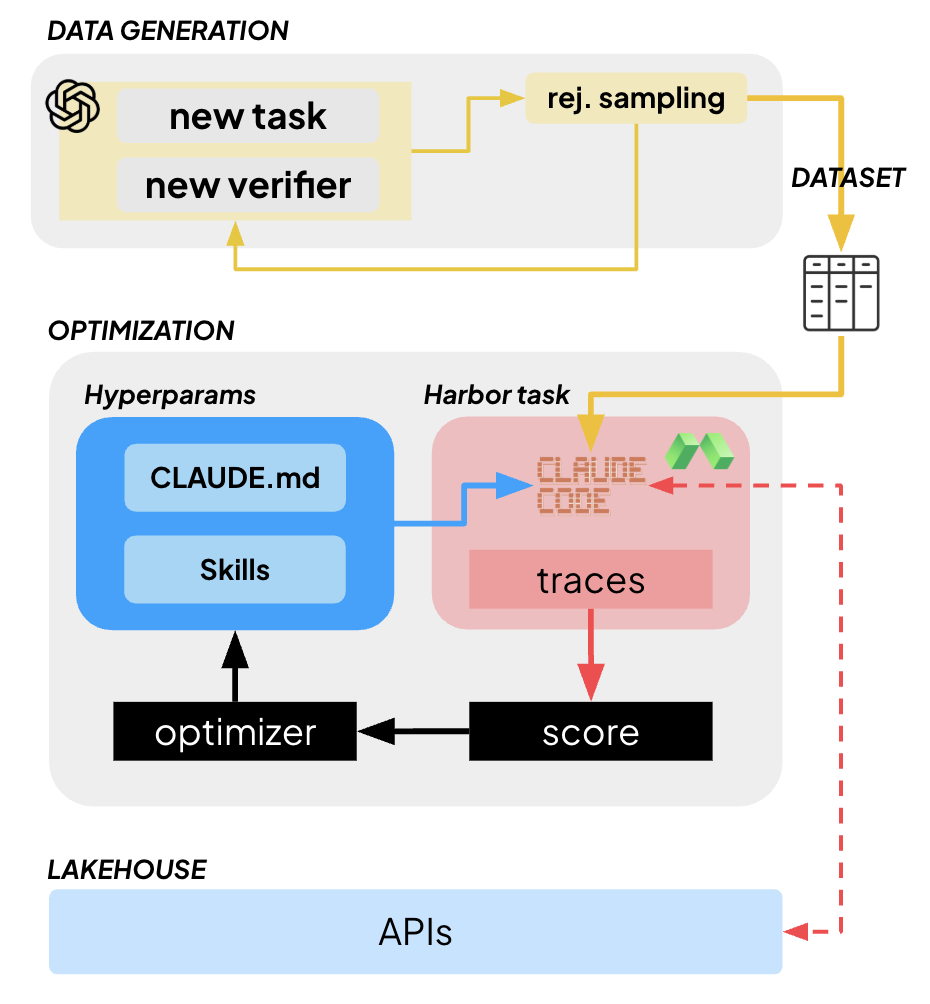
Do you want to try out a more open stack and don’t know how? In our experience, the biggest blocker remains the lack of a proper evaluation framework: whether you go with closed or open models, “vibes” are not enough to make decisions at enterprise scale and properly evaluate trade-offs. To help practitioners with best practices and an open reference implementation, we have just released our evaluation framework, which creates data engineering tasks paired with verification scripts and then runs evaluation at scale using sandboxes: check out the VLDB pre-print!
Conclusion
As usual, we barely scratched the surface: there are many more AI Council topics we could not touch in our review. Thankfully, you can check the full YouTube library for more inspiration! As for us, we already look forward to being back next year; in the meantime, stay tuned for more release announcements and the upcoming talks scheduled for the fall!